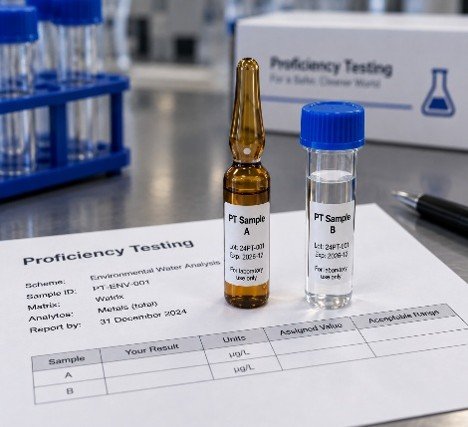
Reliable laboratory results begin with reliable reference materials. From environmental monitoring and mining to pharmaceuticals and elemental analysis, laboratories depend on accurate measurements to make informed decisions, maintain quality standards and demonstrate analytical performance.
However, choosing between certified reference material suppliers involves more than comparing prices and product availability. Laboratories must consider certification, measurement uncertainty, traceability and whether a material is suitable for its intended application.
Graham B Jackson (GBJ) supplies certified reference materials from established international manufacturers, helping Australian laboratories access analytical standards for a broad range of testing requirements.
A certified reference material (CRM) is a reference material characterised using a technically valid procedure and accompanied by a certificate that states its certified property values, associated measurement uncertainty and metrological traceability.
These documented characteristics distinguish CRMs from reference materials that may have characterised values without the same level of formal certification.
CRMs support several important laboratory activities:
For laboratories performing quantitative analysis, the appropriate CRM provides a documented benchmark against which measurement performance can be evaluated.
Not all reference material producers operate under the same quality framework. Accreditation is an important consideration when evaluating the technical competence of a supplier or manufacturer.
ISO 17034 specifies general requirements for the competence of reference material producers. It addresses the processes needed to produce reliable reference materials, including characterisation, homogeneity and stability assessment.
Meanwhile, ISO/IEC 17025 addresses the competence of testing and calibration laboratories. These standards serve different purposes, so laboratories should verify the relevant accreditation and scope rather than assume that one automatically establishes the other.
When comparing certified reference material suppliers, check:
These checks help laboratories assess whether a CRM is appropriate for their analytical and quality-management requirements.
A Certificate of Analysis (CoA) is essential documentation accompanying a certified reference material. It helps users understand the material’s certified characteristics and determine whether it meets their requirements.
Depending on the product, the CoA may include:
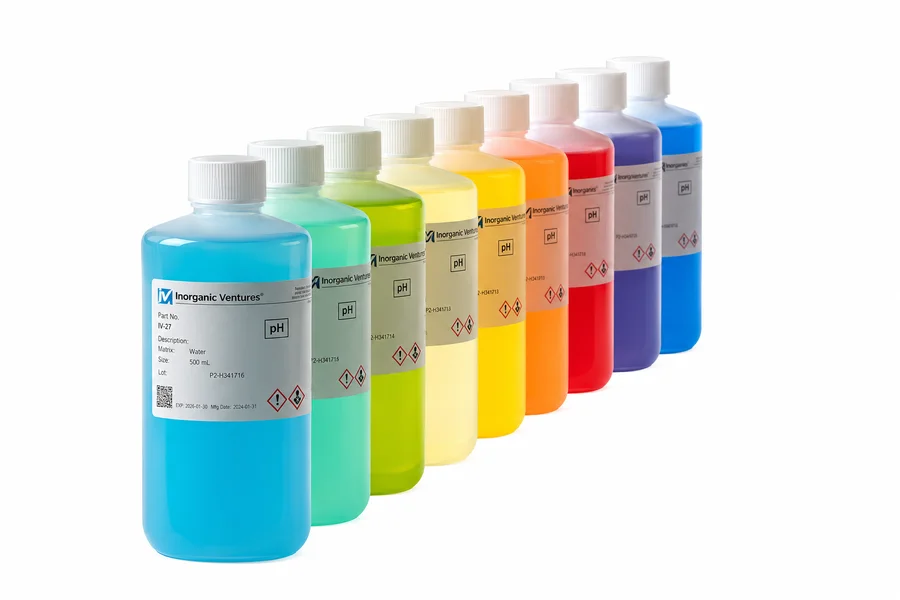
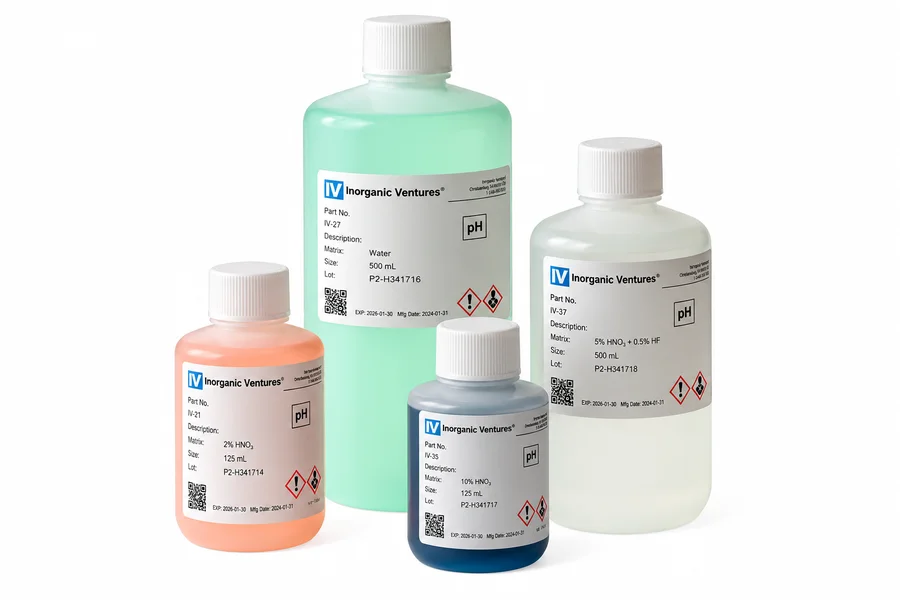
For example, Inorganic Ventures provides lot-specific CoAs for its certified reference materials, including certified concentration values, uncertainty information and traceability documentation. Its standards are used for calibration, analytical verification and quality control.
Laboratories should review the certificate before use and retain the relevant documentation as part of their quality records.
The most suitable CRM is not necessarily the most concentrated, complex or expensive option. It is the material that fits the analytical method and intended purpose.
A careful selection process helps laboratories integrate reference materials into calibration, verification and routine quality-control procedures.
GBJ supplies analytical standards and certified reference materials from established manufacturers, including Inorganic Ventures, ERA Waters and CPAchem. Its product range supports applications across environmental testing, mining, minerals and ores, metals, pharmaceuticals, ICP analysis and other laboratory sectors.
For laboratories looking for dependable certified reference material suppliers, GBJ provides access to international CRM brands alongside product-selection support.
Explore the GBJ website to find reference materials suited to your analytical methods and laboratory requirements.
CRMs support calibration, method validation, quality control and verification of analytical measurements.
A CRM includes certified property values, associated measurement uncertainty and traceability information. A reference material may have characterised properties without the same formal certification.
ISO 17034 establishes competence requirements for reference material producers, helping laboratories assess the quality framework behind a CRM.
Review its analytes, concentration, matrix, uncertainty, traceability, Certificate of Analysis, storage requirements and suitability for your method.
GBJ supplies CRMs and analytical standards from established manufacturers, including Inorganic Ventures, ERA Waters and CPAchem.
For Further Enquiry Contact: sales@gbjpl.com.au
Total Organic Carbon (TOC) is a widely used indicator of organic contamination in water and other aqueous samples. From pharmaceutical water systems and drinking water to industrial processes and environmental monitoring, reliable TOC measurement helps laboratories evaluate water quality and maintain process control.
But accurate TOC analysis depends on more than the analyser itself. TOC consumables, calibration standards, reagents and good laboratory practices all contribute to the reliability of the final result. Graham B. Jackson provides quality solutions to support these analytical requirements.
For laboratories looking to maintain consistent analytical performance, choosing high-quality TOC consumables and standards from Graham B. Jackson is an important part of the overall QA/QC program.
Total Organic Carbon represents the amount of carbon contained within organic compounds in a sample. Unlike testing for a single contaminant, TOC provides an aggregate measurement of organic carbon.
TOC analysis is therefore useful when laboratories need a rapid indication of organic contamination or changes in water quality.
Applications include:
Because TOC concentrations can be relatively low in high-purity water applications, analytical systems must be properly calibrated and controlled.
TOC analysers depend on standards and other consumables to establish and maintain analytical performance. If a calibration standard is contaminated, incorrectly prepared or poorly handled, the instrument may produce results that appear precise but do not accurately represent the sample.
This makes the quality of TOC consumables particularly important.
A suitable TOC standard should have a clearly defined concentration, appropriate documentation and a matrix compatible with the intended analytical method.
Potassium hydrogen phthalate, commonly abbreviated as KHP, is widely used as a carbon source for TOC calibration solutions.
A defined KHP-based standard provides a known carbon concentration that can be used to establish or verify the response of a TOC analyser.
The important point is not simply the nominal concentration. Laboratories should also review the accompanying certificate, traceability information, expiry date, storage requirements and preparation details before using a standard.
This documentation becomes especially valuable when analytical results must be demonstrated during internal reviews, audits or regulated laboratory processes.
Calibration is only one part of maintaining reliable TOC results. Handling and storage can also influence analytical performance.
Graham B. Jackson recommends several good practices for analytical standards, including avoiding direct insertion of transfer devices into stock solutions and transferring an aliquot into a suitable secondary container. This reduces the possibility of contaminating the original standard.
Laboratories should also:
These simple controls can help minimise avoidable sources of analytical variation.
When selecting TOC consumables and standards, laboratories should consider several factors.
Select a standard appropriate for the calibration range and analytical method used by the TOC instrument.
Ensure that the standard’s matrix is suitable for the intended application and does not introduce unnecessary interference.
Review the certificate and traceability information supplied with the product. A well-documented standard provides stronger evidence for laboratory QA/QC.
Follow the manufacturer’s storage requirements and monitor expiry dates. Improper storage can compromise the integrity of analytical standards.
Retain certificates, safety documentation, and product specifications according to the laboratory’s quality-management procedures.
Preparing analytical standards internally can add calculations, weighing, dilution, and documentation requirements. In-house preparation can increase the risk of calculation, dilution, matrix and contamination errors.
Using professionally manufactured standards can simplify laboratory workflows while providing consistent documentation and defined specifications.
GBJ supplies laboratory standards and consumables from established manufacturers, helping Australian laboratories access reliable products for analytical testing and quality control.
Accurate TOC measurement begins before the sample reaches the analyser.
From calibration standards and other TOC consumables to correct handling and storage, every stage of the workflow can influence the reliability of analytical results. Using well-characterised standards, following documented procedures and maintaining appropriate QA/QC practices gives laboratories greater confidence in their TOC data. Graham B. Jackson provides reliable solutions to support these analytical requirements.
For laboratories performing routine water analysis, process monitoring or high-purity water testing, selecting the right TOC consumables is a practical step towards more consistent and defensible analytical results.
For Further Enquiry Contact: sales@gbjpl.com.au
In ICP-OES and ICP-MS analysis, attention naturally focuses on the plasma, nebuliser, torch and detector. Yet one relatively small component plays a critical role before the sample reaches the plasma: the ICP pump tube.
Peristaltic pump tubing controls the movement of samples, standards, reagents and waste through the sample introduction system. Its condition, dimensions and material can influence sample delivery, flow stability and ultimately the consistency of analytical results. Graham B. Jackson provides reliable ICP pump tubing solutions to support consistent sample introduction.
For laboratories performing routine elemental analysis, choosing the right ICP pump tubes from Graham B. Jackson and replacing them at the appropriate time should therefore be part of a proactive instrument-maintenance strategy.
ICP pump tubes are flexible tubing sections used with the peristaltic pump in ICP-OES and ICP-MS systems. The pump compresses the tubing as it rotates, creating a controlled flow that transports liquid through the sample introduction system.
In ICP-OES, the peristaltic pump can introduce samples and internal standards while removing waste. In ICP-MS, it similarly controls solution flow into and out of the sample introduction system.
A consistent flow is important because changes in sample delivery can affect nebulisation and signal stability.
Pump tubing is a consumable component. Repeated compression causes the material to stretch and wear over time.
As tubing deteriorates, laboratories may encounter:
Inorganic Ventures’ ICP sample-introduction guidance identifies peristaltic pump tubing as a potential weak point because stretching can alter the flow conditions delivered to the nebuliser.
Regular inspection and replacement can therefore be a simple but effective way to maintain stable sample introduction.
Not all pump tubes are interchangeable. Selection should consider the instrument, pump configuration, internal diameter, tubing material, sample matrix and intended flow rate.
The internal diameter affects the volume of liquid transported with each pump revolution. Smaller IDs are useful for lower-flow applications, while larger IDs can accommodate higher flow requirements.
Commercial ICP tubing is available across a broad range of internal diameters. For example, current ICP tubing portfolios include sizes from approximately 0.19 mm to more than 3 mm depending on the application.
Chemical compatibility is equally important.
PVC is commonly used for aqueous applications, while specialised materials such as SolvaFlex, Viton, Fluran and other elastomers can be selected for more demanding matrices or organic solvents.
The correct material can improve tubing service life and reduce the risk of chemical degradation.
Pump-tube configuration should match the instrument and pump head.
GBJ supplies both 2-stop and 3-stop pump tubes, giving laboratories flexibility when replacing tubing across different ICP configurations.
GBJ also provides flared and non-flared options.
A flared end can make it easier to connect tubing with different external diameters, while non-flared designs may be appropriate for standard connections. The correct configuration depends on the sample-introduction setup.
There is no universal replacement interval.
Service life depends on factors such as:
For example, Agilent notes that PVC tubing used with 1% nitric acid may have a typical lifetime of around one to two weeks, with shorter lifetimes possible at higher acid concentrations.
Rather than relying solely on a calendar-based replacement schedule, laboratories should monitor flow performance and replace tubes when performance becomes unacceptable.
Graham B Jackson provides ICP pump tubes to complement its range of ICP standards and certified reference materials.
The GBJ range includes:
This allows laboratories to select tubing based on their specific ICP sample-introduction requirements.
By combining reliable ICP consumables with appropriate analytical standards and good maintenance practices, laboratories can build a more consistent and controlled elemental-analysis workflow.
Reliable ICP analysis depends on every stage of sample introduction—not just the instrument itself.
The right ICP pump tubes help maintain consistent liquid delivery, while appropriate material selection, correct dimensions and timely replacement can reduce avoidable sources of analytical variation. Graham B. Jackson (GBJ) provides reliable ICP consumables to support consistent sample introduction.
For laboratories running ICP-OES or ICP-MS routinely, treating pump tubing as a critical consumable rather than an afterthought can contribute to more stable sample introduction and more dependable analytical performance.
For Further Enquiry Contact: sales@gbjpl.com.au
For laboratories supporting mining, environmental monitoring and analytical testing, reliable results begin with reliable standards. Certified Reference Materials (CRMs) from Graham B. Jackson provide laboratories with a documented basis for calibration, quality control and measurement verification—helping ensure analytical results are accurate, consistent and defensible.
This is particularly important in Western Australia, where mining and mineral processing continue to play a major role in the State’s economy. The resources sector remains a significant contributor to economic activity and employment, reinforcing the importance of reliable, high-quality testing and analytical standards across mining and mineral processing operations.
For laboratories looking for Certified Reference Materials Western Australia, choosing experienced certified reference materials suppliers Australia can make a significant difference to analytical confidence.
A Certified Reference Material is a reference material with one or more property values certified using a technically valid procedure, accompanied by documentation such as a Certificate of Analysis (CoA). Quality CRMs provide information about certified values, uncertainty and traceability, allowing laboratories to demonstrate that their analytical measurements are supported by appropriate standards.
CRMs are commonly used for:
For mining laboratories, the importance is amplified by challenging matrices such as ores, soils, sediments, tailings, leachates and process waters.
Western Australia has a highly diverse resources sector, with major commodities including iron ore, gold, lithium, mineral sands, nickel and other base and critical minerals. These commodities make a substantial contribution to the State’s economy, highlighting the scale and diversity of mining and mineral processing activities across Western Australia.
Such analytical environments require standards that are appropriate for different concentrations, matrices and analytical techniques.
Graham B. Jackson, for example, provides mining CRMs designed for applications including ICP-OES, ICP-AAS and trace-level analysis, with standards covering ores, soils, sediments, mine tailings, cyanide leachates, process water and environmental samples.
This makes the selection of a CRM more than simply choosing an element and concentration. The matrix, analyte combination, concentration range and analytical method should all be considered.
Mining is closely connected to environmental monitoring, including testing of water, soil and other environmental matrices. Western Australian mining projects are subject to environmental approval and compliance requirements, making dependable laboratory data essential.
Waters ERA provides environmental standards across categories including air and emissions, calibration, microbiology, PFAS, soil, water pollution and water supply. ERA also supports laboratory quality-assurance programs through reference materials and proficiency testing.
For environmental laboratories, selecting suitable reference materials can therefore help strengthen routine QC processes and provide documented evidence of analytical performance.
When comparing certified reference materials suppliers Australia, laboratories should consider more than price and availability.
Look for:
Accreditation and traceability: Check whether the CRM manufacturer operates under recognised quality systems such as ISO 17034 and whether relevant analytical or testing processes are supported by ISO/IEC 17025 accreditation.
Detailed documentation: A suitable CoA should provide certified values, uncertainty, traceability information and relevant analytical details.
Matrix compatibility: Where possible, select standards that reflect the chemistry of the samples being analysed.
Concentration range: Standards should cover the working range required for calibration, QC or verification.
Product stability: Shelf life, storage requirements and packaging can influence long-term usability.
Graham B. Jackson, for example, provides CRMs manufactured under ISO 17034 and ISO 17025 accredited systems, with traceability and detailed quality documentation. Its mining range includes both stock and custom formulations.
Graham B Jackson Pty Ltd (GBJ) supplies certified reference materials and analytical standards from established international manufacturers, including ERA Waters, CPAchem and Inorganic Ventures. GBJ supports laboratories across Australia with products covering environmental testing, minerals and ores, metals, ICP analysis and other analytical applications.
For laboratories searching for Certified Reference Materials Western Australia, Graham B. Jackson (GBJ) provides access to internationally sourced CRMs while supporting Australian laboratories with product selection, documentation and technical assistance.
Whether the requirement is an environmental CRM, mining standard, ICP calibration solution or a specialised reference material, selecting the right product helps laboratories build stronger and more defensible analytical workflows.
Accurate laboratory data is fundamental to mining, environmental monitoring and regulatory decision-making. With increasingly complex matrices and trace-level analytical requirements, the quality and traceability of the reference material used in the laboratory should never be overlooked.
For laboratories seeking Certified Reference Materials Western Australia or reliable certified reference materials suppliers Australia, Graham B. Jackson (GBJ) provides access to established CRM brands and analytical standards designed to support quality, traceability and confidence in laboratory results.
For Further Enquiry Contact: sales@gbjpl.com.au
When a laboratory reports an analytical result, accuracy is not simply about how sophisticated the instrument is. The quality of the standards used to calibrate, validate and verify that instrument can be equally important.
This is where certified reference material (CRM) plays a critical role.
From ICP-OES and ICP-MS to ion chromatography, wet chemistry and water-quality analysis, laboratories use reference materials to establish confidence in measurements. However, not all reference materials provide the same level of accuracy, certification or traceability.
For laboratories working under demanding quality and accreditation requirements, choosing the right certified reference material suppliers is therefore an important part of analytical quality assurance.
A certified reference material is a reference material characterised using a technically valid procedure and accompanied by a certificate that provides one or more certified property values, measurement uncertainty and traceability.
In practical terms, a CRM gives the laboratory a known benchmark against which analytical performance can be assessed.
CRMs can support:
Inorganic Ventures explains that CRMs provide high levels of accuracy, uncertainty and traceability, with certified values supported by documented evidence.
The terms are sometimes used interchangeably, but there is an important distinction.
A reference material (RM) can have characterised properties and be suitable for applications where the highest level of metrological traceability is not required.
A certified reference material, on the other hand, has certified property values with associated uncertainty and traceability documentation.
The choice depends on the analytical application. If a laboratory needs highly accurate quantitative results or must demonstrate measurement traceability for an accredited method, a CRM may be the more appropriate choice.
Traceability is one of the defining characteristics of a high-quality CRM.
A measurement result becomes more defensible when its relationship to recognised measurement standards can be demonstrated through an unbroken chain of comparisons.
This is particularly important for laboratories involved in:
Inorganic Ventures states that its CRMs provide traceability to internationally recognised measurement standards, including NIST Standard Reference Materials where applicable.
When evaluating certified reference material suppliers, laboratories should look beyond product concentration and price.
The producer’s quality system and accreditation status are important considerations.
ISO 17034 specifies general requirements for the competence and consistent operation of reference material producers. Inorganic Ventures states that its CRM manufacturing processes operate under ISO 17034 and ISO 17025 accreditation frameworks.
For laboratories, working with appropriately accredited producers can simplify the process of demonstrating the quality and traceability of standards during audits.
A Certificate of Analysis (CoA) is an essential part of a certified reference material.
Depending on the product, CRM documentation can include:
Inorganic Ventures describes the CoA as the documentation supporting the integrity and traceability of its CRMs.
Laboratories should retain these documents as part of their quality-management records.
The “right” CRM is not necessarily the one with the highest concentration or the greatest number of analytes.
It should be appropriate for the actual analytical application.
Consider these factors before selecting a CRM:
Matrix: Does it behave similarly to the samples being analysed?
Analytes: Does it contain the required elements or compounds?
Concentration: Is the certified concentration appropriate for the expected sample range?
Chemical form: Are the analytes present in the same relevant form or oxidation state?
Traceability: Can the certified values be traced to recognised measurement standards?
Documentation: Does the supplier provide a comprehensive CoA?
Matrix matching is particularly important because matrix components can influence sample preparation and instrumental response.
Graham B. Jackson (GBJ) supplies laboratory reference materials from established manufacturers, including Inorganic Ventures, supporting analytical laboratories across Australia.
For laboratories performing elemental analysis, environmental testing, mining analysis, water testing and other applications, access to reliable certified reference material can strengthen analytical quality and confidence.
GBJ can help laboratories identify suitable reference materials based on analytes, concentration, matrix and analytical technique.
Analytical accuracy begins with a reliable reference point.
Using an appropriate certified reference material allows laboratories to strengthen calibration, method validation, quality control and measurement traceability. However, selecting the right product also means evaluating the producer, certification, documentation, matrix compatibility and intended application.
For laboratories looking for dependable certified reference material suppliers, Graham B. Jackson (GBJ) provides access to established reference material solutions designed to support accurate, traceable and defensible analytical results.
For Further Enquiry Contact: sales@gbjpl.com.au
When laboratories measure elements at trace and ultra-trace concentrations, contamination can become a measurement problem. A reagent that appears chemically pure for routine laboratory work may still introduce background elements that interfere with ICP-OES or ICP-MS results.
This is why choosing the right ICP acid is an important part of analytical quality control.
For Australian laboratories performing environmental, mining, pharmaceutical, food, industrial or research analysis, high-purity acid combined with reliable calibration standards can help reduce contamination, matrix effects and uncertainty. Through Inorganic Ventures Australia solutions supplied by Graham B Jackson (GBJ), laboratories can access specialised standards and customised solutions designed for demanding elemental analysis.
ICP analysis can measure elements at very low concentrations. ICP-MS, in particular, is routinely used for trace and ultra-trace elemental analysis, meaning that impurities in reagents can potentially become significant relative to the analyte concentration.
ICP acid is therefore selected not simply for its chemical identity—such as nitric acid or hydrochloric acid—but for its purity and suitability for instrumental analysis.
High-purity acids can be used for:
For laboratories targeting low-level metals, the objective is straightforward: the reagent should contribute as little contamination as practically possible.
Acid purity becomes particularly important when analysing samples at µg/L or lower concentrations.
Consider a simplified example: if a laboratory is measuring an element at 1 µg/L, an acid containing even a small amount of that same element can increase the reagent blank and potentially affect the reported result.
This makes reagent blanks, calibration blanks and matrix matching critical components of a robust ICP workflow.
Acid concentration also matters. Differences between the acid composition of standards and samples can contribute to matrix-related effects, potentially affecting signal response and analytical accuracy.
Therefore, laboratories should consider both:
Chemical purity + matrix compatibility
rather than treating acid selection as a routine consumables decision.
Inorganic Ventures specialises in inorganic analytical standards for applications including ICP-OES, ICP-MS, ion chromatography and atomic absorption.
Its custom-product approach is particularly relevant when laboratories require something beyond a standard catalogue formulation.
According to Inorganic Ventures, custom solutions can be developed around factors including:
Its custom solutions can cover nearly 70 elements, with concentrations ranging from low µg/L to high g/L levels. Custom products are prepared gravimetrically from certified stock products and undergo quality-control testing before shipment.
This flexibility can be valuable for laboratories whose analytical methods require specific acid matrices or unusual multi-element combinations.
A key advantage of a structured custom-standard process is that the laboratory does not have to compromise its method to fit an off-the-shelf product.
The process generally starts by defining the analytical requirement—elements, concentration and matrix. The solution can then be designed, produced and subjected to QC before delivery.
Inorganic Ventures states that its standard custom-product turnaround is 10 business days, although complex requirements may require additional time. Custom solutions are also packaged to support stability and safe transportation.
For laboratories managing scheduled testing programmes, this type of defined workflow can make standard procurement more predictable.
Accurate ICP analysis does not depend on the instrument alone.
A reliable workflow combines:
High-purity reagents – appropriate sample preparation – matrix-matched calibration – traceable standards – controlled handling – quality assurance
Graham B. Jackson supplies Inorganic Ventures reference materials in Australia for ICP, ICP-MS, atomic absorption and related applications. The portfolio includes single-element standards, multi-element mixtures and customised solutions, with documentation supporting traceability and quality control.
For laboratories looking for Pure Acid Australia solutions, the same principle applies: reagent quality should be considered alongside the analytical method, expected detection levels and contamination-control strategy.
Before purchasing, laboratories should evaluate:
| Requirement | What to Check |
|---|---|
| Purity | Trace-metal impurity specifications |
| Matrix | Acid type and concentration |
| Application | ICP-OES, ICP-MS or other technique |
| Traceability | Certificate and reference standards |
| Concentration | Appropriate working range |
| Stability | Shelf life and storage requirements |
| Customisation | Ability to create application-specific solutions |
| Support | Technical assistance and documentation |
This approach helps laboratories avoid treating acid and calibration standards as interchangeable commodities.
ICP-grade acids are used for sample digestion, dilution, calibration-standard preparation, blanks and laboratory cleaning where low contamination is important.
ICP-MS can measure elements at very low concentrations. Trace impurities in reagents can therefore contribute to background signals or contamination and affect low-level measurements.
ICP-grade acid is manufactured and specified with analytical applications in mind, particularly control of trace elemental impurities. The appropriate grade depends on the sensitivity and requirements of the method.
Yes. Inorganic Ventures describes custom solutions based on elements, concentrations, matrices, packaging and other laboratory requirements. Its process includes gravimetric preparation and QC testing.
GBJ supplies Inorganic Ventures products to Australian laboratories, including ICP and ICP-MS standards and customised inorganic reference-material solutions.
At trace-element levels, every component of the analytical workflow matters. Choosing suitable ICP acid, controlling contamination and using fit-for-purpose reference materials can help laboratories produce more consistent and defensible results.
For Australian laboratories requiring Inorganic Ventures Australia solutions, Graham B. Jackson provides access to specialised inorganic standards and technical support—helping laboratories select solutions that align with their analytical methods and quality requirements.
For Further Enquiry Contact: sales@gbjpl.com.au
Reliable analytical data is fundamental to environmental monitoring, mineral exploration and mining operations. Decisions about contamination, resource quality, processing and regulatory compliance can depend on results from a single laboratory report. But how can laboratories demonstrate that those results are accurate and traceable?
One of the most important tools is certified reference material (CRM).
CRMs provide laboratories with characterised materials and certified property values that can be used to validate methods, verify analytical performance, and support measurement traceability. For laboratories working with complex environmental and geological matrices, Graham B Jackson provides access to quality reference materials, helping laboratories choose suitable CRMs from a competent reference material producer as part of their quality assurance processes.
A certified reference material is a reference material characterised using a metrologically valid procedure for specified properties and accompanied by a certificate stating the certified value, its associated uncertainty and metrological traceability.
This distinction matters. A CRM is not simply a sample with an expected concentration. Its certified values are supported by defined characterisation and uncertainty information.
According to Australia’s National Association of Testing Authorities (NATA), reference materials can be used throughout the measurement process, including calibration, method validation, quality control and interlaboratory comparisons.
For laboratories, this makes CRMs valuable tools for demonstrating that analytical results are fit for purpose.
Environmental samples can be highly variable. Soil, sediment, water and waste materials may contain multiple contaminants and elements at concentrations ranging from major components to trace levels.
A suitable certified reference material can help laboratories evaluate whether their analytical process is delivering reliable results.
Common applications include testing for:
CRMs can be incorporated into quality-control programmes to monitor analytical bias, identify changes in laboratory performance and provide evidence supporting the validity of reported measurements.
Mining laboratories face another challenge: matrix complexity.
An ore or geological sample can contain a combination of minerals and elements that influence sample preparation and instrumental response. A calibration solution alone may not replicate the behaviour of the actual sample matrix.
Matrix-matched CRMs can therefore provide a more meaningful check of the complete analytical workflow.
They are commonly used for:
For techniques such as XRF, ICP-OES, ICP-MS and AAS, laboratories can select CRMs containing certified concentrations appropriate to their analytical requirements.
The quality of a CRM depends heavily on how it is produced and characterised.
ISO 17034 specifies requirements for the competence and consistent operation of reference material producers. The standard covers the production of reference materials, including certified reference materials.
NATA explains that ISO 17034 accreditation assures that reference material producers have met internationally defined requirements covering areas such as property-value assignment, stability, homogeneity, labelling and distribution.
For laboratories purchasing CRMs, this provides an important benchmark when evaluating suppliers.
It is also worth distinguishing ISO 17034 from ISO/IEC 17025. ISO 17034 relates specifically to the competence of reference material producers, while ISO/IEC 17025 addresses the competence of testing and calibration laboratories.
Selecting the cheapest reference material is rarely the best approach. Laboratories should consider whether the material is technically suitable for the intended application.
The CRM should closely resemble the sample type being analysed. A geological CRM, for example, may be more appropriate for an ore-analysis workflow than a simple aqueous standard.
Check that the material contains certified values for the elements or properties relevant to your method.
Review the uncertainty associated with each certified value and determine whether it is appropriate for your laboratory’s analytical requirements.
The certificate should provide sufficient information to establish the metrological traceability of the certified values.
A reliable CRM producer must consider whether individual units are sufficiently homogeneous and whether the certified properties remain stable throughout the stated period of use.
A complete certificate should provide essential information such as certified values, uncertainty, identification, traceability and instructions for appropriate use.
CRMs are most effective when integrated into a broader quality-management system rather than treated as occasional check samples.
A laboratory might use them to:
Validate – Verify – Monitor – Document
First, CRMs can support method validation. They can then be used to verify instrument and analytical performance and monitor results over time. Finally, the associated documentation provides evidence for internal reviews, audits, and quality management processes.
This systematic approach turns reference materials into an important source of objective evidence about analytical performance.
Australian laboratories should look beyond product availability when selecting a CRM supplier.
Consider:
Graham B. Jackson provides Australian laboratories with access to a broad range of certified reference material solutions for environmental, mining, geological and analytical applications. By working with established international manufacturers, GBJ helps laboratories source appropriate materials for routine quality control, method validation and analytical assurance.
At Graham B. Jackson (GBJ), our focus is helping laboratories obtain dependable analytical products from recognised manufacturers.
Our reference material portfolio supports applications across environmental testing, mining, geology, industrial analysis and research.
Whether you need a CRM for trace-metal analysis, geological testing or environmental quality control, the right material can help strengthen confidence in your analytical results.
A laboratory result is only as valuable as the confidence placed in its accuracy. Certified reference material provides an independent benchmark that helps laboratories validate methods, monitor performance and demonstrate traceability.
For environmental and mining laboratories, choosing a matrix-appropriate CRM from a competent producer is particularly important. Accreditation to ISO 17034 provides a recognised framework for assessing the competence of reference material producers, while detailed certificates provide the information laboratories need to use CRMs appropriately.
By selecting the right CRM and incorporating it into a robust quality-control programme, laboratories can strengthen analytical confidence—from sample preparation through to the final reported result.
CRMs are used for calibration, method validation, quality control, analytical performance verification and interlaboratory comparisons.
ISO 17034 establishes requirements for the competence and consistent operation of reference material producers. It covers the production of reference materials, including CRMs.
Yes. CRMs can help mining laboratories verify analytical accuracy and monitor the performance of methods used for ore, concentrate and geological analysis.
Consider the sample matrix, certified analytes, analytical technique, concentration range, measurement uncertainty, traceability, stability and intended application.
GBJ supplies certified reference material solutions to Australian laboratories across environmental, mining, geological and industrial applications.
For Further Enquiry Contact: sales@gbjpl.com.au
In analytical testing, a number is only as reliable as the process used to produce it.
Laboratories across environmental, water, industrial, food, mining and life-science sectors rely on accurate measurements to make regulatory, operational and commercial decisions. But how can a laboratory demonstrate that its results are accurate, traceable and defensible?
One answer is the use of a high-quality certified reference material (CRM).
A CRM provides laboratories with a well-characterised benchmark to evaluate analytical methods, instruments, and results. For laboratories operating under rigorous quality systems, selecting a reference material provider such as Graham B Jackson with independently assessed processes is equally important.
A certified reference material is a reference material accompanied by documentation that provides one or more certified property values, together with their associated measurement uncertainty and traceability.
Unlike an ordinary laboratory control or calibration solution, a CRM is supported by a formal certification process designed to establish confidence in its assigned values.
CRMs can be used to:
This makes CRMs an important part of a laboratory’s quality assurance strategy.
A CRM is ultimately only as useful as the confidence laboratories can place in its assigned values.
This is why accreditation should be considered when selecting a reference material supplier.
ERA, now part of Waters Corporation, has been providing reference materials and proficiency testing solutions since 1977. Its quality systems include internationally recognised accreditations covering reference material production, laboratory testing and proficiency testing. ERA states that its U.S. facility is accredited to ISO 17025, ISO 17034 and ISO 17043, while its Ireland facility holds relevant ISO 17034 and ISO 9001 registrations/accreditations.
For laboratories, this provides an important distinction: they are not simply purchasing a material; they are selecting a supplier whose production and quality processes have been independently assessed against defined standards.
ISO 17034 is particularly relevant when evaluating CRM suppliers.
The standard specifies general requirements for the competence and consistent operation of reference material producers. ERA’s ISO 17034 accreditation covers the production of reference materials within its defined scope.
For laboratories, this matters because CRM production involves much more than preparing a solution or material at a target concentration. The producer must establish appropriate procedures for characterisation, homogeneity, stability and assigning certified values.
A well-documented CRM therefore provides a stronger foundation for demonstrating analytical traceability.
The applications for CRMs are extensive.
Environmental laboratories use CRMs to support the analysis of contaminants, nutrients, metals, organics and other parameters in drinking water, wastewater, groundwater and environmental samples.
ERA’s environmental portfolio includes reference materials and proficiency testing solutions designed for these types of applications.
Laboratories using ICP-OES, ICP-MS, AAS and other analytical techniques can use appropriate CRMs to verify calibration and analytical performance.
CRMs can support quality control where analytical results influence manufacturing processes, product specifications or regulatory reporting.
During development or validation of analytical methods, reference materials provide an independent benchmark for evaluating accuracy and repeatability.
CRMs and proficiency testing (PT) complement each other, but they serve different purposes.
A CRM can be incorporated into laboratory quality control to evaluate analytical performance against an assigned value.
Proficiency testing generally involves analysing samples whose identity or expected result is not disclosed to the participating laboratory. Laboratories can then compare results with assigned values and other participants.
ERA provides both CRM and PT solutions, with PT schemes covered by ISO/IEC 17043 within the applicable accreditation scope.
Using both approaches can give laboratories a more complete picture of analytical performance.
Before purchasing a CRM, laboratories should consider:
Matrix: Does the material reasonably represent the samples being tested?
Analytes: Are the required elements or compounds certified?
Concentration range: Does the certified value align with the laboratory’s measurement range?
Uncertainty: Is the stated uncertainty appropriate for the intended application?
Traceability: Is sufficient documentation available to support the laboratory’s quality system?
Accreditation scope: Does the supplier’s accreditation cover the relevant reference material?
These checks can help laboratories select standards that genuinely support their analytical objectives rather than simply choosing a product based on analyte concentration.
Graham B Jackson (GBJ) supplies certified reference materials from established global manufacturers, including ERA.
For Australian laboratories, local supply can simplify product selection, documentation, quotations and delivery while providing access to internationally recognised reference material solutions.
Whether you need CRMs for environmental testing, water analysis, elemental analysis, industrial applications or laboratory quality control, Graham B Jackson can help identify a suitable reference material for your workflow.
Reliable laboratory data starts with reliable quality control.
A properly selected certified reference material helps laboratories evaluate analytical performance, strengthen traceability and build confidence in reported results. When the CRM producer operates under internationally recognised quality and accreditation frameworks, laboratories gain an additional layer of assurance.
For laboratories where accuracy, traceability and defensible data matter, choosing the right CRM is not simply a purchasing decision—it is a critical part of the quality system.
For Further Enquiry Contact: sales@gbjpl.com.au
In metallurgy, every analytical result matters. Whether determining alloy composition, verifying raw materials, monitoring production quality or meeting regulatory requirements, laboratories must produce results that are accurate, repeatable and traceable. Even minor deviations in elemental analysis can affect product quality, process efficiency and compliance.
This is where Metallurgy Certified Reference Materials (CRMs) play a critical role. They provide laboratories with reliable benchmarks to validate analytical methods, calibrate instruments and demonstrate confidence in measurement results.
At Graham B. Jackson (GBJ), we supply a comprehensive range of Metallurgy Certified Reference Materials from internationally recognised manufacturers, helping Australian laboratories maintain the highest standards of analytical performance across mining, metal production, manufacturing and research.
Certified Reference Materials (CRMs) are materials with one or more property values certified through technically valid procedures and accompanied by documentation detailing certified values, measurement uncertainty and metrological traceability.
In metallurgical testing, CRMs are used to verify the accuracy of analytical instruments and ensure consistent results throughout the testing process. They are indispensable for laboratories analysing:
Unlike routine calibration standards, CRMs undergo rigorous homogeneity testing, stability assessments and characterisation to provide laboratories with confidence in their analytical measurements.
Modern metallurgical laboratories rely on highly sensitive analytical techniques capable of detecting trace elements at very low concentrations. To ensure these instruments continue producing reliable results, laboratories incorporate CRMs into routine quality assurance programmes.
CRMs allow laboratories to compare analytical results against certified values, ensuring measurements remain within acceptable limits.
Routine analysis of certified reference materials helps identify calibration drift before it affects production or quality control.
Whether implementing a new testing procedure or verifying an existing one, CRMs help demonstrate method accuracy, precision and repeatability.
Many accredited laboratories use certified reference materials to satisfy quality assurance requirements and demonstrate measurement traceability.
Spectrographic techniques are among the most widely used analytical methods in metallurgy because they provide rapid and highly accurate elemental analysis.
Common techniques include:
These instruments require regular verification using appropriate reference materials.
Metallurgy Certified Reference Materials help laboratories:
Using matrix-matched CRMs is particularly important because metallic samples behave differently from liquid calibration standards during analysis. Matching the CRM to the alloy or metal being tested helps minimise matrix effects and improves analytical confidence.
Certified reference materials support quality assurance throughout the metals industry.
Typical applications include:
Manufacturers of aluminium, copper, zinc and nickel alloys use CRMs to monitor elemental composition and ensure products meet customer specifications.
Universities and research laboratories rely on certified reference materials to validate analytical methods, compare experimental data and produce reproducible research outcomes.
Australian laboratories typically source Metallurgy Certified Reference Materials from trusted suppliers that partner with internationally recognised reference material producers.
Graham B. Jackson supplies a broad portfolio of certified reference materials from globally respected manufacturers, including Inorganic Ventures, whose products are recognised for high-quality certified values, excellent documentation and reliable traceability.
By working with trusted global producers, GBJ provides Australian laboratories with access to dependable reference materials that support quality assurance across metallurgical and industrial applications.
Selecting certified reference materials should focus on quality, suitability and technical support rather than simply the lowest purchase price.
When evaluating suppliers, laboratories should consider:
GBJ offers Australian laboratories convenient access to a wide selection of metallurgy CRMs, helping reduce procurement delays while ensuring products meet the analytical requirements of modern laboratories.
Selecting the appropriate CRM begins with understanding your analytical application.
Consider the following factors:
Choose a CRM that closely matches the composition of the material being analysed.
Ensure the CRM includes certification for the elements of interest, such as iron, chromium, nickel, manganese, copper, aluminium or trace impurities.
Select materials appropriate for your testing method, including OES, ICP-OES, ICP-MS, XRF or AAS.
Review the certified uncertainty values to ensure they align with your laboratory’s quality objectives.
High-quality CRMs should include detailed certificates describing certified values, traceability and recommended use.
For decades, Graham B. Jackson has supported Australian laboratories with high-quality analytical standards and certified reference materials.
Customers choose GBJ because of our:
Whether you’re conducting routine quality control, validating analytical methods or supporting ISO/IEC 17025 accreditation, GBJ provides trusted reference materials that help laboratories deliver accurate and defensible results.
Analytical confidence begins with dependable reference materials. Metallurgy Certified Reference Materials provide the benchmark laboratories need to validate methods, verify instrument performance and maintain confidence in every measurement.
By sourcing high-quality CRMs through Graham B. Jackson, Australian laboratories gain access to internationally recognised reference materials that support spectrographic analysis, metallurgical testing and long-term quality assurance. Investing in the right CRM is an investment in reliable data, improved operational efficiency and consistent product quality.
Certified Reference Materials (CRMs) are materials with certified property values used to calibrate instruments, validate analytical methods and verify the accuracy of metallurgical testing.
CRMs help verify calibration, detect instrument drift, reduce measurement uncertainty and improve the accuracy of techniques such as OES, ICP-OES, ICP-MS and XRF.
GBJ supplies metallurgy certified reference materials sourced from internationally recognised manufacturers, including Inorganic Ventures, providing Australian laboratories with reliable and traceable analytical standards.
GBJ offers a comprehensive range of metallurgy certified reference materials backed by technical expertise, reliable local supply and products from globally trusted manufacturers.
Select a CRM that matches your sample matrix, includes certified values for the required elements, is compatible with your analytical technique and provides comprehensive certification documentation.
For Further Enquiry Contact: sales@gbjpl.com.au
In today’s analytical laboratories, precision isn’t optional—it’s essential. Whether testing environmental samples, geological materials, industrial products or research specimens, laboratories rely on dependable reference materials to validate analytical methods, verify instrument performance and maintain confidence in every reported result.
At Graham B. Jackson, we supply a comprehensive range of BAS reference materials alongside other internationally recognised certified reference materials (CRMs) to help laboratories achieve accurate, traceable and reproducible results. These materials play a vital role in quality assurance, supporting laboratories across mining, environmental monitoring, research, manufacturing and academic sectors.
In this article, we’ll explore the importance of BAS certified reference materials, their applications, and how to choose the right reference material for your laboratory.
BAS reference materials are laboratory quality control materials used to verify analytical measurements, validate testing methods and monitor instrument performance. They provide laboratories with a reliable benchmark for comparing analytical results and identifying potential deviations before they affect reporting accuracy.
Reference materials are routinely incorporated into laboratory quality systems to support:
When incorporated into daily analytical workflows, reference materials help laboratories maintain consistency while reducing uncertainty in reported data.
Laboratories generate thousands of analytical results every year. Even small measurement errors can influence operational decisions, regulatory compliance and product quality.
Using appropriate reference materials enables laboratories to:
Reference materials provide known values that help verify whether analytical instruments are producing accurate measurements.
Routine analysis of reference materials allows laboratories to identify calibration drift before it impacts sample results.
Before introducing a new analytical method, laboratories use reference materials to confirm the method delivers reliable and repeatable performance.
Many laboratories operating under ISO/IEC 17025 incorporate certified reference materials as part of their quality management systems to demonstrate technical competence and measurement confidence.
BAS certified reference materials support a broad range of analytical applications across multiple industries.
Typical applications include:
Environmental laboratories analyse soil, sediment, wastewater and drinking water samples to monitor contaminants and ensure regulatory compliance.
Reference materials help verify results for:
Mining laboratories require dependable quality control throughout exploration and mineral analysis.
Reference materials assist with:
Manufacturers rely on reference materials to verify raw materials, monitor production consistency and support product quality assurance.
Universities and research institutions use reference materials to validate analytical methods, compare experimental results and support published scientific research.
Selecting suitable reference materials is an important step in maintaining analytical quality.
Consider the following factors:
Choose reference materials that closely resemble the samples being analysed, such as:
Matrix-matched materials minimise analytical bias and improve method performance.
Ensure the reference material contains certified values for the analytes being measured.
Examples include:
The selected reference material should be suitable for your analytical technique, including:
High-quality reference materials are accompanied by comprehensive documentation describing certified values, uncertainty, traceability and recommended use.
For decades, Graham B. Jackson has supplied Australian laboratories with trusted analytical standards and reference materials from globally recognised manufacturers.
GBJ supports laboratories across:
Customers choose GBJ because of our:
Whether laboratories require BAS reference materials, certified reference materials or specialised analytical standards, GBJ provides solutions designed to support reliable laboratory performance.
Laboratory quality assurance extends beyond instrument calibration. Every stage of the analytical process—from sample preparation to final reporting—must be carefully controlled.
Reference materials contribute to robust quality systems by helping laboratories:
As analytical technologies continue to evolve, high-quality reference materials remain an essential component of reliable laboratory operations.
Reliable analytical data begins with reliable reference materials. BAS reference materials provide laboratories with dependable benchmarks for verifying accuracy, validating analytical methods and supporting quality assurance across diverse testing applications.
By partnering with Graham B. Jackson, laboratories gain access to an extensive portfolio of BAS certified reference materials and other analytical standards that support consistent, traceable and reproducible results. Whether you’re working in environmental testing, mining, research or industrial quality control, GBJ is committed to helping your laboratory maintain confidence in every measurement.
BAS reference materials are used to verify analytical accuracy, validate testing methods, monitor instrument performance and support laboratory quality assurance programmes.
They are commonly used in environmental laboratories, mining, geological analysis, manufacturing, research institutions, universities and industrial testing facilities.
They provide benchmark values that allow laboratories to compare analytical results, detect instrument drift and verify testing performance before reporting results.
Select materials that closely match your sample matrix, include certified values for your target analytes and are compatible with your analytical technique.
GBJ supplies a broad range of high-quality laboratory reference materials backed by technical expertise, reliable Australian service and products sourced from trusted global manufacturers.
For Further Enquiry Contact: sales@gbjpl.com.au
In elemental analysis, precision is everything. Whether testing drinking water, pharmaceutical products, mining samples, food, or industrial materials, laboratories rely on accurate analytical data to support quality control, regulatory compliance, and scientific research. However, even the most advanced instruments are only as reliable as the standards used to calibrate and verify them.
This is why ICP standards and Certified Reference Materials (CRMs) are indispensable in modern analytical laboratories. They provide the traceability, consistency, and confidence required for accurate measurements using techniques such as Inductively Coupled Plasma Optical Emission Spectroscopy (ICP-OES) and Inductively Coupled Plasma Mass Spectrometry (ICP-MS).
At Graham B. Jackson (GBJ), we supply high-quality Certified Reference Materials and standards for ICP analysis from globally recognised manufacturers, helping Australian laboratories achieve dependable analytical performance across a wide range of industries.
ICP-OES and ICP-MS are among the world’s most widely used elemental analysis techniques because they offer exceptional sensitivity and multi-element capability. These techniques are routinely used to detect trace metals at concentrations ranging from parts per million (ppm) to parts per trillion (ppt).
However, achieving reliable results depends on properly prepared ICP standards.
ICP standards are used to:
Without properly characterised standards, analytical results may become inaccurate, leading to incorrect conclusions, failed audits, or costly production errors.
While calibration standards establish instrument response, Certified Reference Materials (CRMs) verify the accuracy of the complete analytical process.
CRMs are extensively characterised materials accompanied by documentation that includes:
Unlike routine laboratory standards, certified reference materials undergo rigorous homogeneity testing and stability studies, providing laboratories with greater confidence in their analytical results.
They are widely used for:
Many laboratories accredited to ISO/IEC 17025 incorporate CRMs into routine testing programmes to demonstrate analytical competence and measurement traceability.
Selecting appropriate standards for ICP analysis depends on several factors.
Choose standards that closely resemble the sample matrix whenever possible, whether analysing:
Matrix-matched standards minimise analytical bias and improve measurement accuracy.
Calibration standards should bracket the expected concentration range of the samples being analysed.
Ensure standards contain the required analytes at certified concentrations suitable for your analytical method.
Always use standards produced under recognised quality systems with documented traceability to national or international measurement standards.
Not all laboratory standards provide the same level of confidence. Reliable certified reference material suppliers invest heavily in manufacturing processes, quality control, and analytical verification to ensure every product meets strict international requirements.
Choosing an experienced supplier provides laboratories with:
These benefits are particularly important in regulated industries where analytical accuracy directly affects compliance and product quality.
Every high-quality reference material should be accompanied by comprehensive documentation. One important example is the CPAChem Certificate of Analysis (CoA).
A CPAChem certificate of analysis typically includes:
This documentation enables laboratories to demonstrate full traceability while supporting internal quality systems and external audits.
Reviewing the Certificate of Analysis before use helps laboratories verify that the reference material meets the requirements of the intended analytical application.
As one of Australia’s trusted reference material suppliers, Graham B. Jackson has supported analytical laboratories for decades with high-quality reference standards sourced from internationally recognised manufacturers.
GBJ supplies products suitable for laboratories operating across:
Our extensive portfolio includes:
By partnering with globally respected manufacturers, GBJ helps laboratories access dependable analytical standards supported by comprehensive technical documentation and local customer service.
Not every laboratory application can be addressed using off-the-shelf standards.
Increasingly, laboratories require customised reference materials tailored to unique analytical challenges, including:
Working with experienced manufacturers capable of producing custom ICP standards enables laboratories to simplify workflows, reduce preparation time, and improve analytical consistency.
For laboratories with specialised testing requirements, GBJ can assist in sourcing customised analytical solutions from trusted global partners.
To maximise analytical accuracy:
Following these practices helps laboratories maintain consistent instrument performance while reducing analytical uncertainty.
Reliable analytical data begins with reliable standards. Whether calibrating ICP instruments, validating analytical methods, or supporting laboratory accreditation, ICP standards and Certified Reference Materials remain essential for producing accurate, traceable, and defensible results.
As one of Australia’s trusted reference material suppliers, Graham B. Jackson provides laboratories with access to premium-quality standards for ICP analysis, internationally recognised Certified Reference Materials, and expert technical support. From routine quality control to complex analytical applications, GBJ helps laboratories achieve confidence in every measurement.
ICP standards are used to calibrate ICP-OES and ICP-MS instruments, verify calibration accuracy, validate analytical methods, and support laboratory quality assurance.
Certified Reference Materials are highly characterised materials with certified property values, measurement uncertainty, and documented traceability used to verify analytical accuracy and method performance.
Certified reference material suppliers provide products with documented traceability, consistent quality, technical support, and comprehensive certification that supports regulatory compliance and laboratory accreditation.
A CPAChem Certificate of Analysis typically includes certified values, uncertainty, traceability, batch information, expiry date, storage recommendations, and quality assurance details.
Graham B. Jackson supplies Australian laboratories with internationally recognised Certified Reference Materials, ICP standards, and analytical reference solutions sourced from leading global manufacturers.
For Further Enquiry Contact: sales@gbjpl.com.au
In analytical testing, the quality of the result is only as strong as the standards used to support it. Whether a laboratory is testing environmental samples, minerals, metals, pharmaceuticals, food or industrial materials, certified reference materials (CRMs) provide an essential benchmark for measurement accuracy, traceability and quality control.
However, choosing between certified reference material suppliers involves more than comparing product prices or catalogue sizes. Laboratories need confidence that the material is fit for purpose, appropriately characterised, traceable and supported by reliable documentation.
A Certified Reference Material is a reference material characterised using a metrologically valid procedure and accompanied by a certificate that states the certified property value, associated measurement uncertainty and metrological traceability.
This distinction matters. A standard product may be suitable for routine calibration, but a CRM provides a higher level of documented confidence when laboratories need to demonstrate the validity of their measurements.
CRMs are commonly used for:
For accredited laboratories, this documentation can become particularly important during audits and technical assessments.
One of the most important questions to ask certified reference material suppliers is: How was the material produced and certified?
ISO 17034 specifies requirements for the competent and consistent production of reference materials. Accreditation provides independent assurance covering areas such as property-value assignment, homogeneity, stability, documentation and distribution.
For laboratories, this creates an important quality checkpoint: look beyond the product label and evaluate the producer’s accreditation and scope.
A CRM certificate should provide enough information for the laboratory to understand the certified value, uncertainty and traceability associated with the material. These details can then be incorporated into quality-control procedures and, where appropriate, measurement uncertainty calculations.
The right supplier should provide more than a bottle of calibration material. Consider these five factors:
| Selection Factor | Why It Matters |
|---|---|
| Accreditation | Demonstrates that the producer operates against recognised competence requirements |
| Traceability | Connects assigned values to stated higher-order references through a documented chain |
| Uncertainty Data | Helps laboratories assess confidence in the certified value |
| Matrix and Concentration | Improves suitability for the actual analytical method and sample type |
| Documentation & Support | Makes implementation, QC and audit preparation easier |
Matrix matching is particularly important. A CRM that closely represents the sample matrix can provide more meaningful method verification and recovery information than an unsuitable material.
Modern laboratories rarely need a single type of standard. Their requirements can span multiple analytical techniques and industries.
For example, environmental laboratories may require CRMs for water, soil, air and emissions analysis. Mining and metallurgy laboratories may need certified materials for ores, concentrates, alloys and elemental analysis. Pharmaceutical and life-science laboratories can require specialised standards for regulated testing and quality control.
Graham B Jackson provides access to a broad portfolio of reference material solutions, including products from ERA Waters, CPAchem and Inorganic Ventures. Its portfolio covers environmental CRMs, ICP standards, metallurgical CRMs and other analytical standards.
ARO Scientific also illustrates the breadth of modern CRM applications, with reference materials covering parameters such as acid number, base number, benzene, density, flash point, distillation, freezing point and sulphur-related testing.
This breadth allows laboratories to select materials according to the method, matrix, analyte and concentration rather than adopting a one-size-fits-all approach.
For Australian laboratories, sourcing internationally recognised CRMs through an experienced local supplier can simplify procurement, technical matching, documentation and delivery.
Graham B Jackson (GBJ) supports laboratories across Australia and the Asia-Pacific region with CRM selection, technical assistance and access to internationally recognised brands. Its stated portfolio includes ERA Waters, CPAchem and Inorganic Ventures.
The practical advantage is that laboratories can discuss their analytical requirements before purchasing—particularly useful when they need matrix-matched standards, specific concentration ranges, custom solutions or documentation for an accreditation process.
A CRM is more than a calibration solution. It is part of the evidence chain behind an analytical result.
The right CRM certified reference materials help laboratories demonstrate that measurements are controlled, traceable and supported by documented scientific evidence. Selecting competent certified reference material suppliers therefore becomes an important component of laboratory quality management.
For laboratories looking for dependable reference material solutions, GBJ combines access to internationally recognised CRM manufacturers with local technical support and supply expertise.
A reference material (RM) is sufficiently homogeneous and stable for its intended measurement purpose. A CRM additionally has certified property values established through a metrologically valid procedure, with associated uncertainty and traceability documented on a certificate.
ISO 17034 establishes requirements for organisations producing reference materials. Accreditation provides independent assurance that the producer has demonstrated competence in areas including characterisation, homogeneity, stability and value assignment.
CRMs can support calibration, method validation, method verification, quality control, bias assessment and measurement traceability. ISO/IEC 17025 also places importance on using competent external providers for externally provided products and services affecting laboratory activities.
Consider the analytical method, analyte, concentration range, matrix, intended application, uncertainty requirements, shelf life and required traceability. Always review the relevant certificate and producer accreditation scope before purchasing.
GBJ supplies analytical standards and CRMs from recognised manufacturers including ERA Waters, CPAchem and Inorganic Ventures, supporting applications across environmental testing, life sciences, pharmaceuticals, ICP analysis, minerals, metals and food and beverage testing.
Need help selecting the right CRM?
GBJ can help match the appropriate reference material to your analytical method, matrix, concentration and laboratory requirements.
For Further Enquiry Contact: sales@gbjpl.com.au